


19 Oct What If You Can’t Pay Your Tax Bill? HMRC Time to Pay Arrangements Explained
If you cannot pay your tax bill in full, acting early can give you options. Receiving a tax bill that you cannot currently afford can feel overwhelming, particularly when your business cash flow is already under pressure.
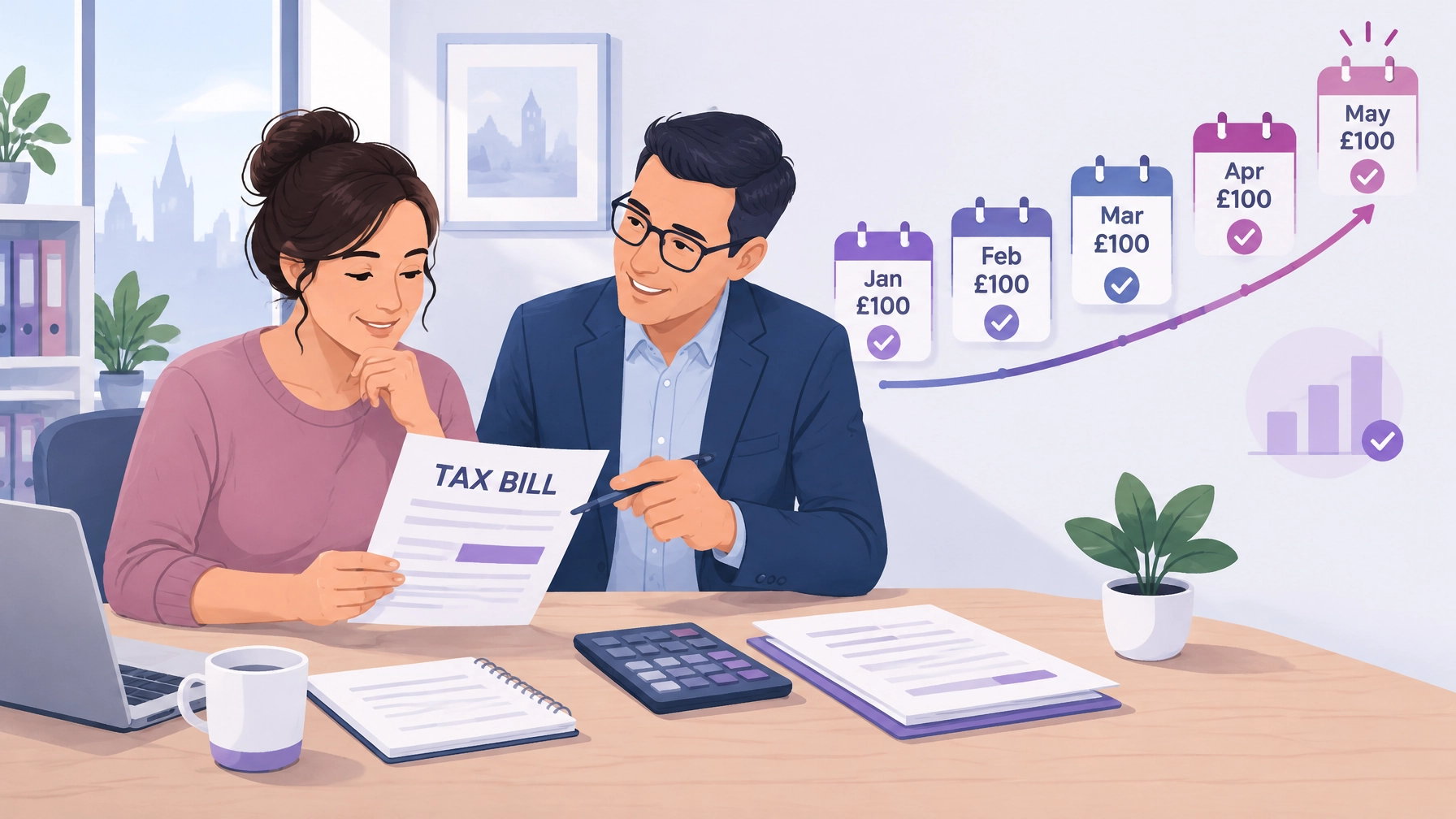
However, you are not expected to solve the problem by ignoring it. HMRC may agree a Time to Pay arrangement, allowing you to repay the tax in instalments that reflect your financial position.
A Time to Pay arrangement is not a tax write-off and it is not an automatic entitlement. It is an agreement with HMRC to pay what you owe over an agreed period.
Most importantly, requesting one is not, by itself, a black mark against you. It shows that you are engaging with HMRC and trying to resolve the debt.
What is a Time to Pay arrangement?
A Time to Pay arrangement gives you more time to settle an existing HMRC debt.
Instead of paying the whole amount by the original deadline, you agree to make regular payments. HMRC will look at what you can realistically afford and usually expects the debt to be cleared as quickly as is practical.
A payment plan may be relevant if you owe:
- Self Assessment tax as a sole trader or individual
- Corporation Tax as a limited company
- VAT
- PAYE and National Insurance as an employer
- Other tax debts administered by HMRC
Your personal and company tax debts are separate. For example, if your limited company owes £12,000 in VAT but you personally owe £4,000 through Self Assessment, these may need to be discussed separately.
A Time to Pay arrangement is also different from a Budget Payment Plan. A Budget Payment Plan helps you make advance payments towards a future Self Assessment bill. Time to Pay deals with tax that is already due or overdue.
You can read HMRC’s official guidance on setting up a payment plan.
Is a Time to Pay arrangement a black mark?
An agreed arrangement is generally a responsible way to deal with a temporary cash-flow problem.
It is not the same as refusing to pay, and it is not the same as formal insolvency. HMRC does not publish your payment arrangement as a public record in the way a County Court Judgment may appear.
That said, the arrangement is recorded on HMRC’s systems. If you apply for finance, a lender may still ask about your tax liabilities, cash flow and ability to meet regular payments. You should therefore treat the arrangement seriously and make sure the payments are sustainable.
HMRC is more likely to work constructively with you when you:
- Contact them promptly
- Explain the situation honestly
- Have filed all the relevant returns
- Offer an amount you can genuinely afford
- Continue paying new tax liabilities as they fall due
So, a Time to Pay arrangement is not something to feel ashamed about. It is a practical solution when your business or personal cash flow is temporarily out of step with your tax bill.
How do you set up a payment plan with HMRC?
You can start online or contact HMRC’s Payment Support Service.
The online route
HMRC has an online service that checks whether you may be eligible to set up a payment plan. You will usually need:
- The relevant tax reference or payment reference
- Your UK bank account details
- Authority to set up a Direct Debit
- Details of your income and spending
- Company income and spending information if the debt belongs to your company
You can use the HMRC online payment-plan service to check your options.
The online route may not be available for every type or size of debt. If you cannot use it, or your circumstances are more complicated, contact HMRC directly.
Calling HMRC
The appropriate phone number depends on the tax involved:
- Self Assessment: 0300 200 3820
- VAT: 0300 200 3831
- Employer PAYE: 0300 200 3819
- Corporation Tax: 0300 200 3840
These lines are generally open Monday to Friday, 8am to 6pm, excluding bank holidays. Check the HMRC payment problems contact page before calling, as contact details and opening times can change.
You can also start with HMRC’s digital assistant for payment problems.

How long will the arrangement last?
HMRC will usually want the shortest period that you can maintain comfortably.
There is no universal instalment amount. The right figure depends on:
- The size of the debt
- Your disposable income
- Your expected future income
- Essential household or business costs
- Savings and investments
- Other debts
- Upcoming VAT, PAYE, Corporation Tax or Self Assessment liabilities
A few months may be realistic for a smaller temporary shortfall. A business proposal lasting around six to twelve months may be considered where the cash-flow forecast supports it. Longer arrangements are possible in some circumstances, but they normally require more detailed information and justification.
Consider these examples:
- A sole trader owes £4,800 and can pay £1,200 immediately, leaving £3,600. A proposal of roughly £600 per month over six months, plus continuing interest, may be more credible than offering £100 per month without an explanation.
- A limited company owes £18,000 in Corporation Tax. If its forecast shows that it can safely pay £3,000 per month, clearing the debt over six months may be appropriate. If the forecast only supports £1,500 per month, the company needs to explain why and show how it will also meet future tax bills.
These figures are examples, not HMRC rules or guarantees. Do not offer an amount simply because it sounds acceptable. If you agree to £1,000 per month but your forecast only supports £650, the arrangement may fail later.
What does HMRC look at?
HMRC wants evidence that your proposal is affordable and achievable.
You may be asked:
- Why you cannot pay the bill in full
- How much you can pay immediately
- How much you can pay each month
- What income you expect
- What your essential spending is
- Whether you have savings or investments
- Whether you own significant assets
- What other HMRC debts you have
- How you will pay future tax liabilities
If a company is in tax debt, HMRC may expect the directors to consider available resources, including releasing suitable assets, arranging finance or contributing personal funds where appropriate.
This does not mean you should make promises that put your household or business at risk. It does mean you should prepare a realistic picture of your finances.
Do interest and penalties continue?
A Time to Pay arrangement does not freeze the debt.
Late-payment interest normally continues to accrue on unpaid tax until it is cleared. HMRC interest rates can change, so check the current HMRC interest rates when preparing your calculations.
Penalties are separate from interest. The exact rules depend on the tax involved and the relevant tax period.
For example, Self Assessment late-payment penalties can apply at different stages after the deadline. Where HMRC agrees a Time to Pay arrangement and you follow its terms, the arrangement may prevent some further late-payment penalty accrual. However, penalties that have already been charged may still remain payable.
Do not assume that the penalty rules for Self Assessment apply in exactly the same way to VAT, PAYE or Corporation Tax. Ask your accountant or HMRC to confirm the position for your specific debt.
What should you do before calling HMRC?
Preparation will make the conversation clearer and help you avoid offering an unrealistic payment.
Before contacting HMRC:
- Check the bill carefully. Confirm the tax type, tax period, amount and payment reference.
- File any outstanding returns. You must keep filing even if you cannot pay.
- Separate personal and company debts. A director’s personal Self Assessment bill is not the company’s Corporation Tax or VAT bill.
- Prepare a short cash-flow forecast. A thirteen-week forecast can help you see what is genuinely available.
- Work out an immediate payment. Even a part-payment may show that you are taking action.
- Calculate a sustainable monthly amount. Include essential costs and future tax liabilities.
- List savings, investments and significant assets. HMRC will expect you to consider whether these can reduce the debt.
- Protect money held for payroll and VAT. Do not treat tax collected from customers or employees as ordinary working capital.
- Keep records of your conversation. Note the date, adviser’s name, agreement details and payment dates.

What happens if you miss an instalment?
Contact HMRC immediately if you think a payment may fail.
Do not cancel the Direct Debit, ignore letters or wait until the next missed payment. Explain what happened and ask whether the arrangement can be reviewed.
If you miss an instalment without contacting HMRC, it may:
- Withdraw the arrangement
- Ask for the remaining balance
- Allow further interest and penalties to build up
- Pass the debt into further recovery action
HMRC’s guidance on unpaid tax explains the possible recovery steps. These can include debt collection activity and enforcement powers in serious cases.
However, all is not lost if you have a genuine problem. Contacting HMRC early gives you the best chance of agreeing a revised solution.
Time to Pay versus ignoring the bill
The difference is communication and a plan.
Ignoring a tax bill does not make it disappear. Interest and penalties may continue, and HMRC can escalate recovery action if you do not respond.
A Time to Pay arrangement, by contrast, means that you:
- Acknowledge the debt
- Explain your circumstances
- Agree a payment schedule
- Make the payments on time
- Continue meeting new tax obligations
If your company cannot pay HMRC, employees, suppliers and other creditors generally, the issue may be more serious than a temporary cash-flow gap. In that situation, obtain professional advice promptly, including insolvency advice where appropriate.
How Harrison’s Accountancy can help
The right figures can make an anxious conversation more manageable.
At Harrison’s Accountancy, we can help you understand what you owe, prepare cash-flow information and assess what you may be able to afford.
We support both sole traders and limited companies with tax returns, bookkeeping, management accounts and practical business advice.
If you are worried about a tax bill, speak to us before the situation becomes more difficult. A calm review of the numbers can help you decide whether a Time to Pay arrangement is appropriate and what proposal is realistic for you.

No Comments