


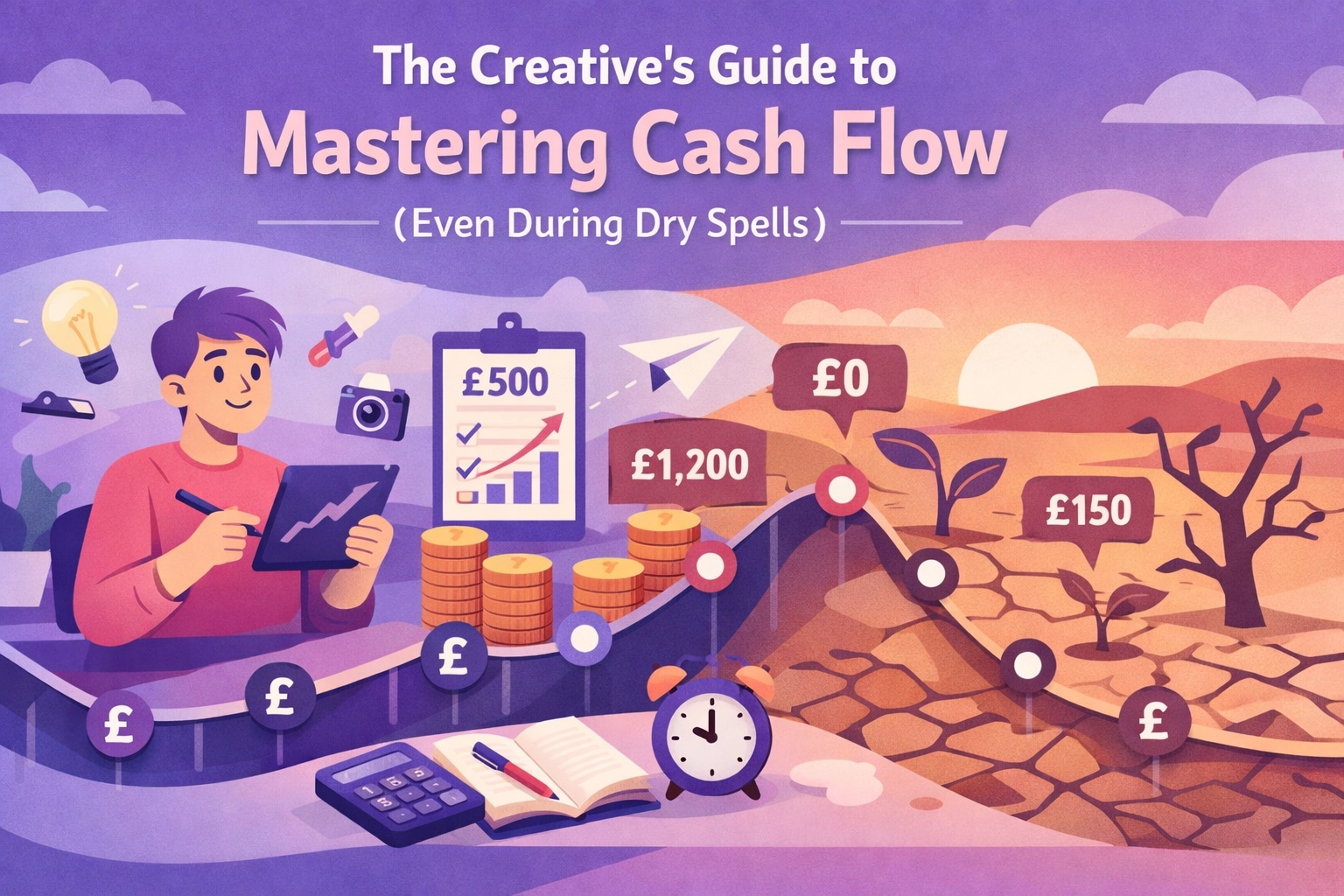
29 May The Creative’s Guide to Mastering Cash Flow (Even During Dry Spells)
How do you keep your business afloat when one month you’re drowning in work and the next you’re refreshing your inbox every five minutes?
If you’re a creative freelancer, whether you’re a graphic designer, a copywriter, a videographer, or an illustrator, you know the "feast or famine" cycle all too well. One minute, the projects are rolling in, and you feel like a billionaire. The next, the "dry spell" hits, and suddenly that expensive coffee habit feels like a questionable life choice.
I’m Dan Harrison, and at Harrison’s Accountancy, we’ve worked with countless creatives who are brilliant at their craft but feel like they’re constantly playing catch-up with their bank accounts. Managing cash flow isn't about being a math genius; it’s about setting up simple systems so you can focus on what you actually love doing.
Let’s look at how you can master your money and make those dry spells a lot less scary.
Step 1: Stop Treating Your Business Account Like a Personal Piggy Bank
Separate your personal and business finances immediately to gain a clear view of what you actually have.
The biggest mistake I see? Using one bank account for everything. When your client pays that £2,000 invoice, it looks like you’ve got £2,000 to spend. But you don’t. Some of that is for the taxman, some is for your software subscriptions, and some is for your future self.
Open a dedicated business account. In fact, open three:
- The Income Account: Where all your client payments land.
- The Tax Pot: Where you move a percentage of every single payment immediately.
- The Operating Account: Where you pay your business bills from.
By separating these, you stop the "accidental spending" of money that was never really yours. If you’re using tools like Xero, this becomes even easier because you can see your real-time balance without the clutter of your grocery shopping or Netflix subscription getting in the way.

Visual: A simple diagram showing £ income flowing into three distinct pots: Taxes, Business Expenses, and Personal Pay.
Step 2: Build Your "Peace of Mind" Buffer
Aim to save at least three months of net income to act as a financial cushion during quiet periods.
In the creative world, dry spells aren't a matter of "if," but "when." A major client might pause a project, or the industry might just go quiet over the summer. This is where your buffer comes in.
Think of your buffer as your "sanity fund." When you have three months of expenses tucked away in a high-yield savings account, a quiet month isn't a crisis; it’s an opportunity to work on your own branding, take a course, or finally update your portfolio.
How to build it without feeling the pinch:
- In "feast" months, don't increase your lifestyle. Keep your personal "salary" the same.
- Take 10% of every invoice and move it into a separate "Emergency Fund" account.
- Once you hit your three-month target, you can start being more adventurous with your reinvestments.
Step 3: The Tax Trap (and How to Avoid It)
Setting aside tax money as you earn is the only way to avoid a panic-inducing HMRC bill in January.
There is nothing worse than getting to the end of the year, seeing a £5,000 tax bill, and realizing you spent that money on a new camera lens or a desk upgrade six months ago.
As a rule of thumb, move 25–30% of every invoice into your "Tax Pot" the second it hits your bank. It’s tempting to keep it in your main account "just in case," but trust me, it’s much easier to sleep at night knowing your HMRC obligations are already covered.

Visual: A calendar showing a peaceful January with a "Tax Bill Paid" checkmark and a stack of £ notes set aside.
Step 4: Rethink Your Billing Strategy
Stop waiting until the end of a project to get paid; use upfront deposits and retainers to stabilize your income.
If you’re waiting 30 days after a project finishes to see any cash, you’re basically giving your clients an interest-free loan while you struggle to pay your rent.
To fix your cash flow, you need to change how you bill:
- The 50/50 Rule: Ask for 50% upfront before you even open your laptop. This covers your immediate costs and ensures the client is committed.
- Milestone Payments: For long projects, bill at specific stages (e.g., 25% at start, 25% at first draft, 25% at second draft, 25% on delivery).
- Retainers: This is the "holy grail" for creatives. Can you offer a client 10 hours of work a month for a set fee of £X? Regular, predictable income is the ultimate cure for cash flow anxiety.
Don't be afraid to be firm about this. Professional clients expect professional payment terms. If you need help structuring your advisory or contract terms, we’re always here to chat.
Step 5: Using Management Accounts as Your "Crystal Ball"
Management accounts aren't just for big corporations, they are the key to predicting your business's future.
Most freelancers only look at their numbers once a year when they do their tax return. That’s like looking at a map of where you were twelve months ago while trying to drive a car today.
"Management Accounts" sounds fancy, but it really just means looking at your profit and loss, your upcoming invoices, and your expected expenses on a monthly or quarterly basis. This allows you to see trends.
For example, you might notice that you always have a "dry spell" in November. With that knowledge, you can spend September and October ramping up your marketing or saving a bit extra to cover the dip. Knowing the numbers takes the emotion out of the dry spell. Instead of thinking "I'm failing," you think "Ah, it's November: time to execute the plan."

Visual: A laptop screen showing a simple bar chart of monthly £ income versus £ expenses, highlighting a predicted gap and a "Safety Buffer" overlay.
Step 6: Pay Yourself First (The Right Way)
Treat your own salary as a non-negotiable business expense rather than taking whatever is left over.
It’s easy to fall into the trap of paying every supplier, every subscription, and every tax bill, and then living off the "scraps." This is a fast track to burnout.
Calculate what you actually need to live comfortably and set that as your fixed monthly salary. Even in a feast month, don't take more. Even in a famine month, try to ensure your business has enough of a buffer to pay you that base amount. This creates personal stability, which makes you a better, more creative business owner.
Step 7: Manage Your Expenses Relentlessly
Keep your overheads low and your eyes on where every pound is going.
During a dry spell, every pound matters. Review your subscriptions once a quarter. Are you still using that £50-a-month stock photo site? Do you really need the "Pro" version of that project management tool?
Using Accountancy services like ours can help you spot these leaks. We often find that small, recurring costs are what actually drain a creative’s cash flow, rather than the big, one-off purchases.

Visual: A person looking at a mobile app showing a list of small £ deductions with a "Cancel Unused" button next to one.
Final Thoughts: You’ve Got This
Mastering cash flow isn't about restricting your creativity; it’s about protecting it. When you aren't worried about how you’re going to pay the electricity bill next month, you have the mental space to do your best work.
Start small. Open that tax pot account today. Set aside 20% of the next payment you receive. It’s those small habits that build a resilient, sustainable creative business.
If you’re feeling overwhelmed by the numbers or want to move beyond just "surviving" the dry spells, we’d love to help. From setting up your Xero accounts to providing deep-dive management reports, we’re here to make the "boring" stuff easy so you can get back to creating.
Want to chat about your cash flow? Get in touch with us at Harrison's Accountancy today. We’re friendly, we talk like real people, and we know exactly how to help your creative business thrive.

No Comments